
Quality and durability are fundamental to reliable infrastructure. That is why quality must be ensured throughout an asset’s life cycle — from construction to operation — through the use of certified materials, compliance with construction standards and methods, and regular assessment of roads and bridges.
“Road Scientific and Technical Center” (Dorcentr), a state enterprise under the Agency for Restoration, is responsible for quality control of road infrastructure.
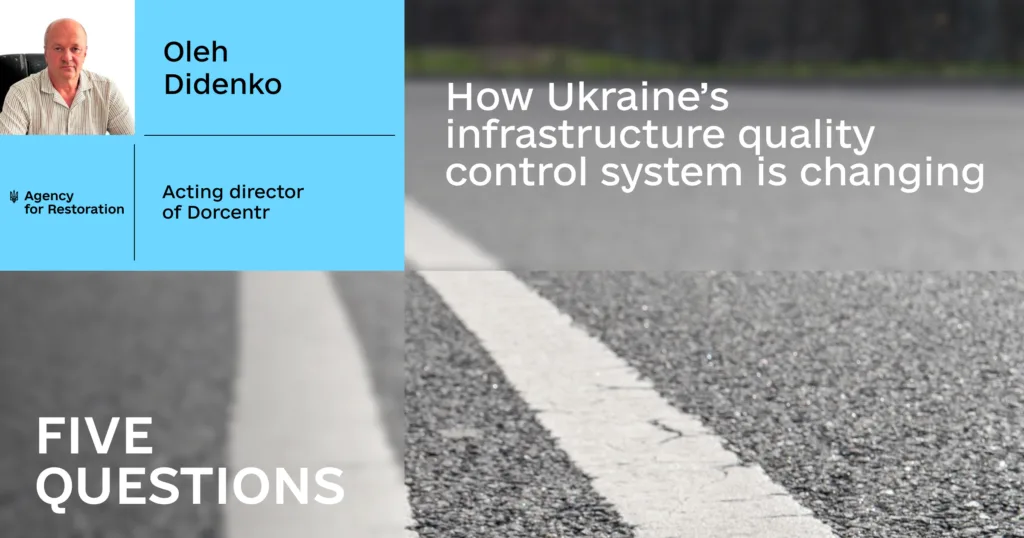
For our Five Questions series, we speak with Oleh Didenko, Acting Director of Dorcentr, about the enterprise’s evolving role in Ukraine’s recovery efforts, modern approaches to infrastructure quality control and diagnostics, and preparations for the future reconstruction of airports.
1. Dorcentr is undergoing a transformation, taking on new functions in assessing the conformity of construction products. How do you see Dorcentr’s new role in infrastructure recovery?
For more than 20 years, Dorcentr has been responsible for quality control of road infrastructure: we inspect materials, construction works and the condition of roads. Today, our role has expanded significantly.
In November 2025, we received accreditation from the National Accreditation Agency of Ukraine (NAAU) as a product certification body under ISO/IEC 17065. In August 2026, we received a certificate from the Ministry of Economy and Environment designating us to perform conformity assessment tasks for construction products.
This has expanded our mandate. We have moved from quality control of individual infrastructure projects to assessing products used in construction and placed on the market. These include bitumen, emulsions, asphalt mixtures and aggregates, all of which are subject to stringent safety and quality requirements.
The practical benefit is straightforward: Ukrainian manufacturers can undergo conformity assessment under System 2+ in Ukraine without having to engage foreign bodies. It is faster and less expensive and, most importantly, more transparent.
This is how I see our new role: Dorcentr is an independent technical body within the recovery system, providing quality control throughout the entire life cycle of a road — from certifying materials at the manufacturing stage to assessing completed infrastructure five or ten years after it enters service.
2. Modern diagnostics make it possible to assess the condition of roads and bridges and anticipate problems before critical defects appear. How does this work, and can the data collected help shift the focus from emergency response to preventive maintenance?
A crack or pothole is only the visible result of processes that may have been developing within the structure for years. Understanding what caused the damage requires specialized equipment and expert assessment.
Instrument-based diagnostics provide a comprehensive picture of a road’s condition. We assess the geometric characteristics of the pavement, including longitudinal and transverse evenness and rut depth. We also measure skid resistance, which directly affects road safety, as well as the structural strength of the pavement — how well its layers withstand traffic loads and whether there are any signs of weakening.
Structural strength assessments allow us to identify potential problems early. Structural performance begins to decline long before cracks become visible on the road surface. If we detect a decline in load-bearing capacity on a section that still appears to be in good condition, this is a warning that deterioration could begin within two or three seasons. If the problem is identified early enough, the road can be preserved through surface treatment or a thin overlay rather than requiring major rehabilitation.
The difference in cost is enormous. That is the economic value of timely diagnostics.
The same principle applies to bridges. We carry out two types of work on engineering structures: technical documentation and inspection. Technical documentation provides a comprehensive picture of the structure, while inspections allow us to assess its condition, identify defects and determine whether repairs or structural strengthening are required.
All data are entered into the Analytical and Expert Bridge Management System. A single inspection provides a snapshot of the structure’s condition, while a series of inspections shows how its condition deteriorates over time.
This allows us to set priorities: where repairs are needed immediately and where they can be postponed. The key requirement is comprehensive and regularly updated data.
3. One of Dorcentr’s responsibilities is verifying Weigh-in-Motion (WIM) systems. How effectively can these systems protect roads from overloaded vehicles, and what is needed for them to work properly?
Let me start with the scale of the problem. Trucks exceeding legal weight limits damage roads much more quickly, so even a relatively small number of overloaded vehicles can have a significant impact on road conditions.
Weigh-in-Motion (WIM) systems make it possible to monitor vehicles around the clock without stopping them. Our role is to verify that the systems are functioning properly and that their data are accurate. Weight and dimension control is effective only when its measurements can be trusted.
For WIM to operate effectively, it requires good-quality pavement, regular inspection and calibration, and data that have legal validity. When these conditions are met, a recorded weight violation can automatically result in enforcement action against the carrier. Without them, WIM is simply an expensive traffic counter.
4. Large-scale recovery will require enormous quantities of construction materials. How can quality control cover the entire chain — from materials production to the completed asset — rather than taking place only after construction is finished, and ensure that the infrastructure we build today lasts for decades?
Quality control that begins only after construction is completed merely identifies a problem rather than preventing it. At that stage, the only way to correct a mistake may be to redo the work.
That is why quality control must be in place at every stage — from the production of materials through the operation of the completed asset.
The first stage is production. This is where certification and production assessment come into play. We assess not just an individual sample, but the manufacturer’s ability to consistently produce materials that meet the declared specifications. That is a fundamental difference.
The second stage is the construction site. This is where technical supervision and engineering support come in: we monitor not only the quality of materials but also compliance with construction methods, the sequence of works and the actual characteristics of the completed structure.
The third stage is operation and maintenance. Diagnostics allow us to assess how the asset performs over time and whether it meets the original design expectations.
What makes Dorcentr distinctive is that all three functions are brought together within a single organization that is independent of the designer, manufacturer and contractor. We neither build infrastructure nor sell construction materials, which allows us to assess the results objectively.
The digital component is also important. All test results are stored in a laboratory quality control information system. This means that even years later, it is possible to verify when, by whom and how a particular result was obtained.
5. Ukraine will need to rebuild its airports after the war. Dorcentr is already developing cooperation in the aviation infrastructure sector. Which technologies and capabilities currently used for roads could also be applied to the reconstruction of airfields?
Airfield pavement involves the same fundamental engineering principles, but with a much smaller margin for error.
Laboratory testing of materials can be applied with virtually no changes. This includes asphalt concrete, cement concrete, bitumen, aggregates and subgrade soils. These materials are already covered by the scope of our accreditation.
The second area is assessing structural load-bearing capacity. For an airfield, this is a critical parameter because it determines which types of aircraft a runway can safely accommodate.
Pavement evenness and skid resistance are equally important. On a runway, these characteristics directly affect braking safety.
Our experience in inspecting engineering structures and structural elements can also be applied to aviation infrastructure.
The regulatory framework will require further work. Aviation infrastructure is governed by its own requirements, including international standards. We are therefore working to expand the scope of our accreditation and adapt our methodologies to aviation standards.
This is not an ad hoc initiative. Expanding our diagnostic capabilities and strengthening international integration are already part of our strategic development priorities. Airport reconstruction may begin sooner than many expect, and we need to have the necessary technical capacity in place before it does.