
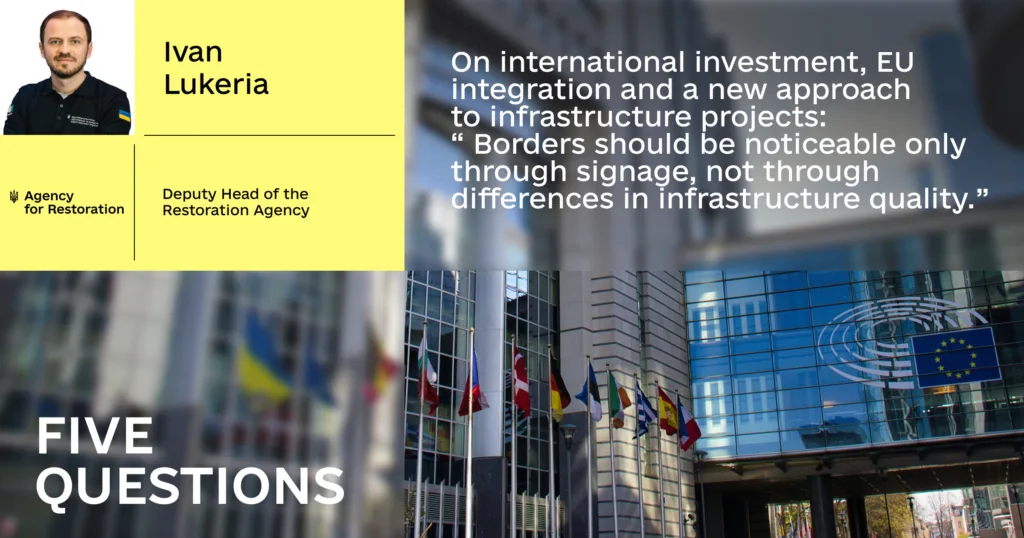
The international investment portfolio stands at €1.8 billion. Which projects are most strategically important for Ukraine’s EU integration?
The Agency’s international investment portfolio is currently focused on road infrastructure and the modernization of border crossings—both critical to Ukraine’s integration into the EU.
That said, it would be misleading to single out individual projects as more or less strategic. Under current conditions, every repaired kilometer of road and every solution that accelerates border and military logistics is significant—particularly as Ukraine continues to operate under full-scale war. At the same time, the country has reached the fastest pace of EU integration in its history, and maintaining that momentum is essential.
Each of our projects, supported by the EBRD, the World Bank and the European Investment Bank, is part of a broader, more systemic vision of Ukraine’s future—where crossing borders should be noticeable only through signage, not through differences in infrastructure quality.
How realistic is it for Ukraine to become a “sea-to-sea” transit country within a few years after the war ends?
This is an entirely achievable goal—provided there is sustained, coordinated effort by the state, international partners and business both now and in the early post-war years.
Ukraine benefits from a strong geographic position, inherent transit potential and growing European demand for more resilient logistics routes. But “sea-to-sea” status is not just about geography. It depends on infrastructure quality, border capacity, the speed of procedures, regulatory alignment with the EU, and the overall reliability of logistics.
Achieving this within a few years is realistic, though it is likely to be gradual rather than immediate. Ukraine will need to steadily consolidate its role as a key logistics and transport hub linking the Baltic, Black and Adriatic regions.
This is not a distant ambition, but an immediate task. And it is precisely how effectively we rebuild and modernise infrastructure today that will determine how quickly Ukraine can realise this potential tomorrow.
What are the tangible results of transforming the Agency’s work with international financial institutions such as the EBRD, EIB and the World Bank?
The key outcome has been a shift from fragmented project execution to a structured, predictable model aligned with the expectations of international financial institutions.
A unified framework has been established, with clear project prioritisation, streamlined preparation, centralised management and full-cycle oversight. This enables partners such as the EBRD, EIB and the World Bank to engage more efficiently and with reduced risk.
And, perhaps most importantly, we are gradually moving from a reactive to a proactive model: not simply implementing individual projects, but building an investment portfolio that is aligned with national priorities and the logic of Ukraine’s EU integration.
What are the main obstacles to infrastructure project implementation today—financing, permits, staffing or security?
There is no single constraint, but rather a combination of interrelated factors.
Security remains the primary challenge. Work in frontline regions, the risk of attacks and the need for additional protective engineering solutions all affect both timelines and costs.
Financing is the second major factor. Demand significantly exceeds available resources, making prioritisation and efficient allocation of funds critical.
Procedures and project preparation also remain a challenge. While significant progress has been made in simplification and standardisation, the speed of decision-making continues to be a key factor in large-scale reconstruction.
Finally, there are capacity constraints—both within public institutions and across the market. Delivering multiple complex infrastructure projects simultaneously requires strong engineering, managerial and technical capabilities.
At the same time, it is important to note that we are already systematically addressing these challenges through centralised project management, cooperation with international partners and the introduction of more efficient implementation approaches. These are not insurmountable barriers, but areas where efforts are currently concentrated.
Which single project in the current portfolio would you describe as a symbol of Ukraine’s future reconstruction?
Honestly, it is difficult to single out one project as a symbol, as Ukraine’s reconstruction is taking place across multiple areas simultaneously.
But in a broader sense, I would point not to a specific asset, but to an approach: the modernization of border infrastructure and the development of transport corridors to the EU—literally the physical integration of Ukraine with the European Union in infrastructure terms.
These projects combine efficient use of funds, alignment with European standards and direct economic impact. They open Ukraine to trade, investment and people.
Each upgraded border crossing and each repaired road to the border is more than infrastructure. It reflects a new quality of interaction with Europe and what Ukraine will look like after reconstruction: modern, integrated and open.
In that sense, the symbol is this transformation itself—a process in which infrastructure shifts from a weak point to a driver of growth for the entire country.