
The Training Center in Bila Tserkva, part of the Agency for Restoration, trains skilled workers for Ukraine’s reconstruction. Programs cover road machinery operators, tractor drivers, welders and drivers, including retraining courses.
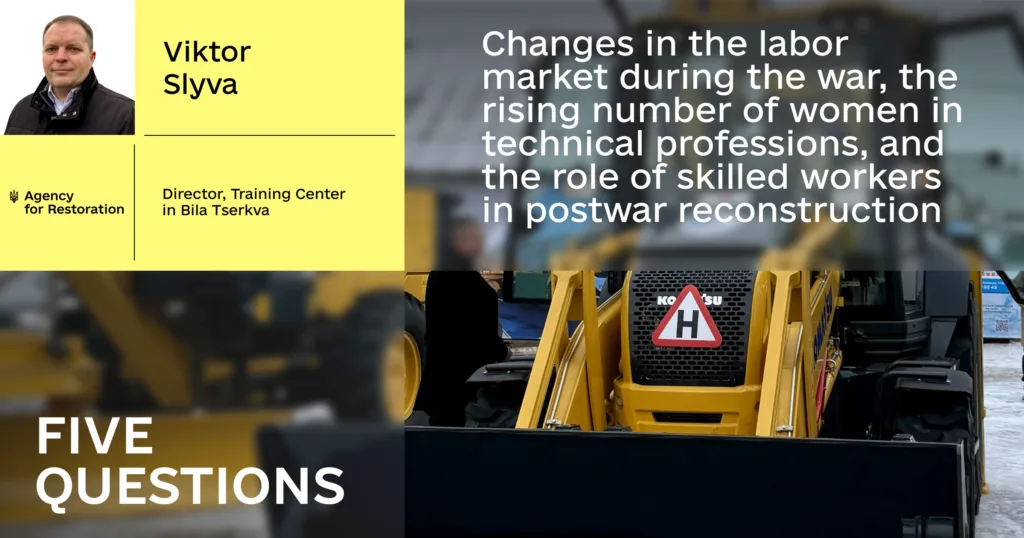
Viktor Slyva, the center’s director, spoke about shifts in the labor market during the war, new trends in technical professions and the role of skilled workers in Ukraine’s postwar recovery.
1. How has demand for your programs changed since the full-scale invasion, and which professions are most in demand?
— The number of trainees fell sharply after the full-scale invasion. In 2021 we graduated two groups of motor grader, road roller and excavator operators each year. By the end of 2025, none had been formed. Enrollment in driver programs also declined, while demand for electric and gas welders and tractor drivers increased.
In response, we launched two new programs in 2025 for agricultural tractor operators in categories B1 and B3 — combine operators and tractor drivers for harvesting root crops, potatoes and vegetables.
We also work closely with employment centers and social protection authorities to support the professional reintegration of veterans and internally displaced persons. For many, retraining offers a path to stable employment and a renewed sense of security.
The war has also changed the structure of the labor market, with greater involvement of specialists who are not subject to mobilization. For example, women now enroll more frequently in tractor operator programs. The same is happening in welding: previously there were almost no women in these programs, but today they are training and finding jobs. In many cases employers refer them directly and hire them after graduation.
Another growing area is training women as bus and passenger car drivers. These specialists will later work in passenger transport, including transporting children, elderly people and persons with disabilities, as well as supporting humanitarian programs.
2. How does training at your center differ from traditional vocational schools?
— People who come to our center usually have a clear goal: to obtain a specific trade. That differs from traditional vocational schools, where students enroll after the ninth grade without necessarily knowing which profession they want to pursue.
Most of our trainees are changing professions or upgrading their qualifications. Many already have employers but lack formal certification, skills or practical experience.
Practical training is our priority. Courses last between 2.5 and 5.5 months depending on the profession. Tractor driver and welding training takes place during the day, while drivers attend theory classes in the evening, with practical training always held during the day.
Training is funded either by the trainee or by the employer. For veterans and internally displaced persons referred by employment or social protection authorities, the state covers the cost.
The center is also unique in Ukraine in offering training for operators of self-propelled road rollers with smooth drums, asphalt paving machines and mobile asphalt mixing plants.
3. What is the center’s main advantage, and how do you plan to develop it?
— Our key advantage is short-term programs. For example, a tractor driver qualification can be obtained in six months, covering theory, machinery systems and practical operation. In traditional vocational schools this training can take about two years.
Looking ahead, we plan to expand licensed programs and continue cooperation with employment centers and social protection authorities. We are also working to introduce dual education, where theory is taught at the center and practical training takes place directly with employers.
We also plan to introduce inclusive training for category B drivers, reflecting new social needs.
4. How has international support — particularly equipment from JICA — affected training quality?
— Equipment provided by the Government of Japan through the Japan International Cooperation Agency (JICA) significantly upgraded the center’s technical base. Trainees can now practice on modern machinery that reflects real working conditions.
This improves training quality, makes the learning process more effective and strengthens the center’s competitiveness.
5. What role do skilled workers play in Ukraine’s postwar recovery?
— Skilled workers are the foundation of postwar reconstruction. They rebuild damaged infrastructure, roads and bridges. Without them, a full and rapid recovery of the country would be almost impossible.