
Restoration of infrastructure in Ukraine requires new approaches — transparent, efficient, and technology-driven. That is why the State Agency for Restoration and Infrastructure Development of Ukraine (SARDI) is implementing BIM technologies (Building Information Modeling) as one of the key tools of digital transformation in construction.
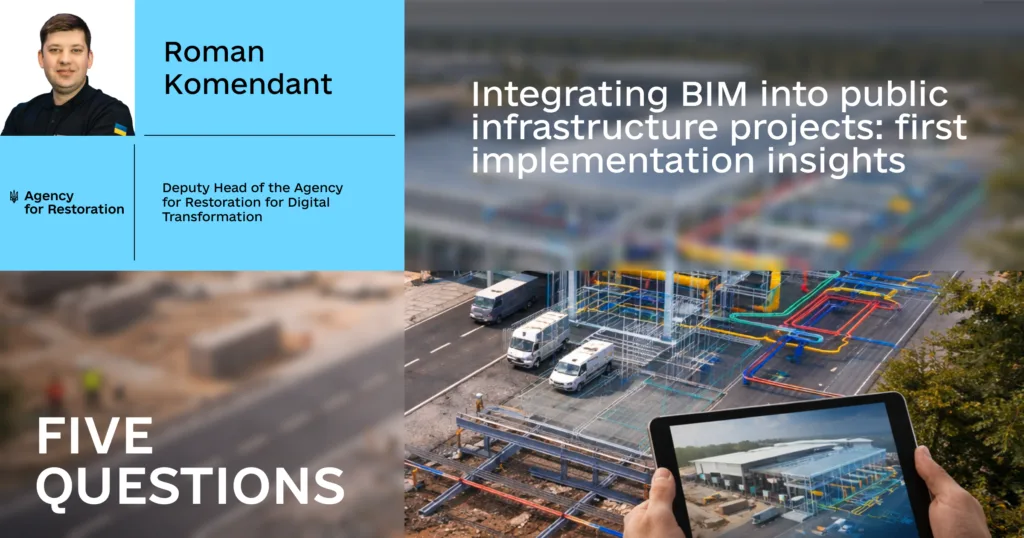
Roman Komendant, Deputy Head of the Agency for Restoration and Chief Digital Transformation Officer (CDTO), discusses the opportunities BIM creates for public infrastructure projects and the first experience of its implementation.
1. What is BIM and why is it important for modern construction?
BIM, or Building Information Modeling, is a modern approach to managing construction projects based on digital data. It is not merely a 3D model, but a comprehensive information system that integrates architectural, engineering, cost-estimation, and operational data.
For the state, BIM is a critically important instrument of sectoral digital transformation because it ensures:
- data-driven management decision-making;
- reduction of design and construction errors at early stages;
- transparency in the use of budget funds;
- control over cost and timelines throughout the entire life cycle of an asset;
- creation of a digital asset base for state infrastructure to support further operation.
In essence, BIM shifts construction from a “problem-response” model to one focused on forecasting, risk management, and long-term efficiency.
2. What are the advantages of using BIM for public projects?
The primary advantage of BIM is control. It provides full visibility into how project changes affect cost, timelines, resources, and risks — a critical capability for large infrastructure projects, where mistakes are extremely costly.
BIM also enhances transparency and accountability, which are essential for public clients. It streamlines collaboration among designers, contractors, and the client, while establishing a strong foundation for data-driven infrastructure management and preventing costly errors before construction even begins.
Beyond this, BIM ensures:
- transparency in the use of budget funds and accountability;
- a unified information environment for all project participants;
- shorter approval and review timelines;
- accumulation of digital data for further management and operation of infrastructure;
- a foundation for large-scale digitalization of the construction sector at the national level.
In practice, BIM becomes not only a design tool but also an instrument of public management of infrastructure assets throughout their entire life cycle.
3. Please tell us about the pilot BIM implementation project at SARDI
The pilot BIM implementation project is the construction of a border crossing point at Yahodyn. We deliberately chose a complex infrastructure facility in order to test BIM in real conditions of multidisciplinary interaction and public project management.
Within the framework of the pilot, we aim to create a comprehensive digital model integrating design solutions, engineering networks, construction schedules, and cost-estimation data. This makes it possible to:
- improve coordination among project participants;
- strengthen control over timelines and cost;
- respond more quickly to changes and risks;
- form a digital foundation for the facility’s further operation.
The main value of the pilot lies not only in delivering a single project, but in refining an approach that can be scaled to other public infrastructure facilities.
4. What challenges did SARDI face at the start of BIM implementation?
The greatest challenge is not technology, but teams and processes. BIM requires changes in project management approaches. It is necessary to train personnel, adapt procedures, and ensure compatibility of digital tools.
This is challenging, but at the same time extremely valuable — it shapes a new management culture: open, systematic, and result-oriented. Even now, digital approaches make it possible to avoid errors and work more efficiently.
Key challenges include:
- training and upskilling specialists;
- adapting regulatory and internal procedures;
- ensuring interoperability of digital tools;
- restructuring interaction among project participants.
At the same time, this stage is strategically valuable, as it forms a new management culture — open, systematic, and focused on results. Digital approaches already allow for reducing errors, accelerating decision-making, and increasing the efficiency of public project implementation.
5. What are the plans for scaling BIM in SARDI’s projects?
This is our strategic objective — to make BIM the standard for large infrastructure projects implemented by SARDI. After the pilot, we plan to scale this approach to road construction, bridge restoration, transport and social infrastructure.
In the long term, we see BIM as the foundation of a unified national digital ecosystem for managing infrastructure assets, aligned with international standards and the principles of GEDSI — gender equality, disability and social inclusion.
Background
SARDI views the implementation of BIM technologies not merely as the execution of individual pilot initiatives, but as a strategic instrument for deep institutional transformation of approaches to infrastructure planning, construction, and management. The use of BIM is a key element in the transition from fragmented processes to an integrated, data-driven model of infrastructure asset management throughout their entire life cycle.
SARDI is implementing its first pilot BIM project — the construction of the Yahodyn border crossing terminal. The project is supported by the UK Foreign, Commonwealth & Development Office (FCDO) in partnership with Connected Places Catapult and aims to develop approaches for the use and scaling of BIM in Ukraine’s public infrastructure projects.
At the same time, this pilot is part of the broader transformation strategy of SARDI, aimed at integrating BIM as a standard approach to delivering large-scale infrastructure projects. The experience gained will form the basis for developing national data requirements, digital standards, management procedures, and decision-making processes that will later be applied in road construction, bridge restoration, transport, and social infrastructure.
The pilot project for the construction of the Yahodyn border crossing terminal serves as a foundation for developing practical methodologies, data requirements, digital standards, and management procedures that can be applied in public infrastructure projects across the country.
In the long term, BIM is regarded as the foundation of a unified state digital ecosystem for infrastructure asset management — from strategic planning and design to operation, maintenance, and modernization. This approach will ensure compliance with international standards, integration of transparency, accountability, and efficiency principles, and systematic implementation of gender equality, accessibility, and social inclusion (GEDSI).
International partnership within the framework of BIM implementation plays an important role not only in transferring technological solutions, but also in supporting the strategic transformation of SARDI into a modern, digital institution capable of effectively managing Ukraine’s reconstruction in line with global best practices.