
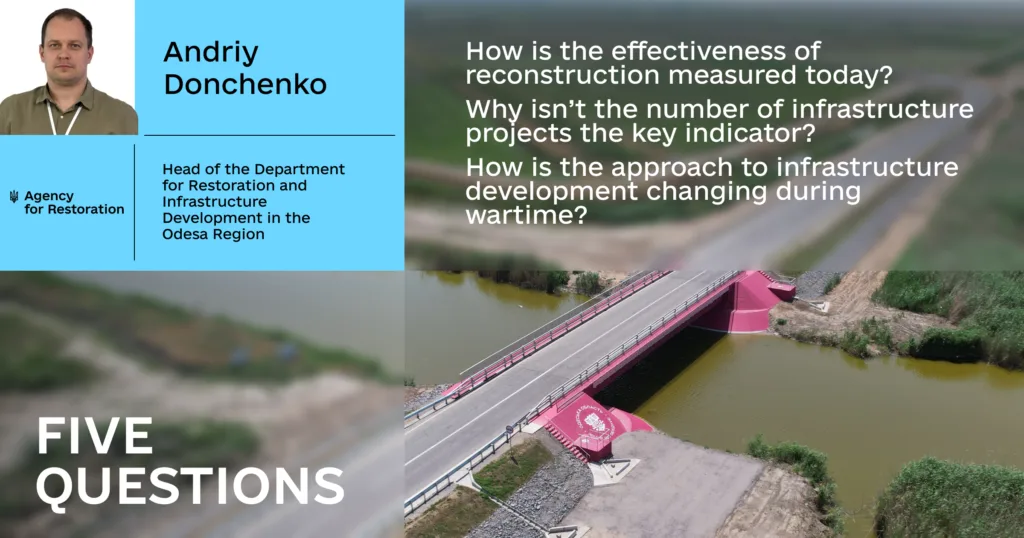
Andrii Donchenko, Head of the Service for Restoration and Development of Infrastructure in Odesa Region, explains how the effectiveness of reconstruction is measured, why infrastructure projects are no longer assessed by the number of completed facilities, and how the logic of project design is changing under constant risks. He also discusses the emerging contractor market, the role of local communities, and the competition for international resources.
1) Reconstruction involves billions of hryvnias in state and international funding. How do you prove that these funds are being used effectively? What is your main KPI as a manager?
Today, effectiveness is about proven results and trust in the system. This marks a very important shift in approach.
Whereas previously the key indicators were often the number of completed facilities or the amount of funding allocated, we are now working with a much more complex evaluation framework. First of all, there is the basic discipline of implementation: a project must be completed within the established timeframe, without unjustified cost increases, with verified quality and full compliance with the design solutions. But this is only the first level.
The second level is the functional impact. We assess whether the project actually solves the problem it was created to address. For example, if it is a road — has travel time decreased? If it is a border crossing point — have queues been reduced? If it is engineering infrastructure — has the system become more stable and reliable?
And the third, most important level, is the systemic impact. Are people returning? Is economic activity recovering? Are new businesses emerging? Is trust in the area increasing? For me as a manager, this is the main KPI.
Because in the context of war and reconstruction, the priority is not simply to repair a facility, but to restore the normal functioning of the environment and create the conditions for future development.
2) What is currently hindering reconstruction? And what can you realistically change at your level?
It would be wrong to point to just one reason — it is always a combination of factors.
On the one hand, state procedures remain complex, which objectively affects the speed of implementation. On the other hand, the contractor market has not yet fully adapted to the new requirements — speed, quality, and the ability to operate under constant risk. A third factor is managerial coordination, especially when many stakeholders are involved in the process.
However, the most important thing is not the list of problems, but the area of influence.
At our level, we focus on three key areas. First is clarity in management: it must be clearly understood who the client is, who is responsible, and who makes decisions. Second is the quality of project preparation, because this directly determines the speed of financing and implementation. And third, there is the discipline of execution, specifically monitoring, technical supervision, and a prompt response to deviations.
In other words, we cannot instantly change the entire system, but we can ensure that within our area of responsibility it operates predictably, efficiently, and with clear results.
3) The Odesa region is regularly under attack. Do you ever have to repair the same facilities multiple times? How does this affect your approach to reconstruction? Does the design logic change to account for repeated damage?
This is a complex but very important question, and we need to be frank about it.
Yes, the risk of repeated damage exists, and in some cases, facilities are indeed damaged more than once. But it is incorrect to interpret this as the state “paying twice for the same thing.” In reality, it is about something else—a shift in the approach to reconstruction under conditions of constant risk.
We no longer operate under the logic of “restoring things to the way they were.” That approach has lost its meaning. Today, every project is considered from the perspective of resilience: how it will function under threats, what will happen in the event of repeated damage, and how quickly functionality can be restored.
This means that the very logic of design is changing. We incorporate:
- backup solutions for critical functions;
- redundancy of key engineering systems;
- load distribution to avoid a single point of failure;
- modularity and maintainability so that the facility can be quickly restored;
- reinforcement of structural elements where appropriate.
In fact, design is becoming not just an engineering task but also a scenario-based one: we immediately consider not only how a facility will operate under ideal conditions, but also how it will behave during a crisis.
As a result, each subsequent stage of reconstruction is not a repetition of the previous one, but a qualitatively different level of resilience. And the main task is to ensure that even in the event of damage, the system does not “completely fail,” but continues to perform its functions at least partially.
Therefore, it is more accurate to speak not of double costs, but of the fact that we are gradually transitioning to an infrastructure model that is adapted to risks and capable of withstanding them.
4) Are there contractors who specialize specifically in rapid recovery and working in crisis conditions?
Yes, the contractor market has changed significantly during the war, and it’s fair to say that a new class of companies has emerged—ones capable of working faster and more responsibly.
These contractors are distinguished not only by their technical capabilities. They organize their work differently: they have mobile resources, make quick decisions, work simultaneously on multiple sites, are ready to operate in high-risk conditions, and do not shirk responsibility. They understand that today, results are measured not by the process but by the outcome—whether the work is done well and on time or not.
At the same time, the market is very heterogeneous. There are some companies that have failed to adapt to these requirements—they work slowly, miss deadlines, make quality errors, or lack sufficient resources.
And here, the approach must be entirely pragmatic.
We operate strictly within the framework of contracts and the law. If a contractor misses deadlines without objective reasons, penalties are imposed. If quality is not ensured, defects are documented with mandatory rectification, or contract termination is initiated. If violations are systematic, such a contractor effectively loses the opportunity to work with us in the future.
An important mechanism is also being established: reputation and track record of contract fulfillment. The market now quickly identifies who is actually delivering results and who is not. Our task is to ensure results. If that means terminating the contract or replacing the contractor, we’ll do it.
5) How do you personally define the success of reconstruction: is it the number of completed projects, or when people return to normal life?
To put it simply, the number of projects has never been and cannot be the main measure of success. It’s important as an indicator of progress, but it doesn’t guarantee anything on its own. You can complete dozens of projects, but they don’t improve people’s lives or the state of the economy.
For me, the success of reconstruction is a much broader concept. It is the moment when infrastructure ceases to be a “project” and begins to function as a living environment. When people return not out of necessity, but because it is once again possible to live there. When small and medium-sized businesses open. When schools, hospitals and transportation are operational.
In other words, true success is when an area transitions from a state of “recovery” to a state of normal functioning and development. When life begins to flourish around it, economic processes get underway, and trust grows. And that is when reconstruction truly makes sense.
6) To what extent are communities involved in the reconstruction process? Do they influence decisions about what to rebuild and how?
Today, communities are no longer passive recipients of the outcome—they have become full-fledged participants in the reconstruction process, and this is one of the key changes that have taken place during the war.
Essentially, it is at the community level that the initial needs are identified: what has been destroyed, what needs to be restored first and foremost, and which solutions will actually work in specific conditions. No one understands what is most important to them better than local authorities and the residents themselves.
Community participation is not just a “list of needs.” It also influences the format of decisions. For example, what is more appropriate: a quick temporary solution or a full-scale reconstruction, how to organize the space, how to integrate the facility into daily life. These are practical matters that are often overlooked without community involvement.
At the same time, there is another level—prioritization. And this is where the regional and national levels come in. Because resources are always limited, decisions must be made not only from the perspective of local importance but also in terms of systemic impact: where the project will yield the greatest results for the largest number of people or for the economy as a whole.
That is why today’s model looks like a partnership. The community formulates a request and provides insight into real needs, while the regional and national levels provide assessment, resources, and implementation.
7) Given the large volume of work and the labor shortage, how do you build your team? Do you feel a shortage of specialists, and how do you address this?
The labor shortage today is not just a problem, but one of the key constraints on reconstruction. And it is felt at all levels: from engineers and designers to technical supervision and management positions.
But it is important to understand: the issue is not just the number of people, but the fact that the very nature of the work has changed. Today, we need not just people with degrees, but people who are capable of working in conditions of uncertainty, making quick decisions, and taking responsibility for them.
Therefore, building a team means creating a flexible system that combines different competencies.
First, there is the core of the team—experienced specialists who understand the processes and regulatory framework and can manage complex projects from start to finish.
Second, there are young professionals whom we actively recruit. They adapt more quickly, embrace new approaches more easily, and bring dynamism to the team.
Third, there is external support—consultants, project organizations, and technical experts. We operate as an open system.
And one more important point is working with the market. We effectively outsource some functions to contractors, but at the same time, we strengthen control and quality requirements.
And the key point is that today, the winner isn’t the one with the most people, but the one whose team works cohesively and is focused on results, not the process.
8) Rebuilding energy infrastructure is one of the key challenges. What solutions are currently being implemented to make facilities more resilient to attacks and outages?
Restoring energy infrastructure today means transforming the existing energy supply model—from a vulnerable centralized system to one that is resilient, flexible, and risk-adaptive.
The first key area is the decentralization of generation. More local power sources are emerging: autonomous units, small-scale generation, and backup systems. This allows critical facilities to operate even when the centralized grid is partially out of service.
The second area is system redundancy and backup. We are establishing alternative power lines, additional connections, and load balancing. The goal is to avoid a situation where a single strike or accident “knocks out” the entire system.
The third is infrastructure segmentation. Systems are designed to operate as independent units. If one segment is damaged, the others continue to function.
Fourth is energy efficiency and consumption optimization. The lower the load on the system, the easier it is to maintain it under crisis conditions. That is why modern facilities are designed from the outset with energy savings in mind.
Fifth is digital control and management. Monitoring systems allow for quick responses to changes, load redistribution, and the prevention of critical failures.
Ultimately, we are moving toward a model where the goal is not simply to “provide light,” but to ensure operational continuity even under challenging conditions.
9) What role does border infrastructure play in the region’s development? What are the key challenges?
For the Odesa region, border infrastructure is one of the key drivers of the regional economy. In today’s environment, the role of border crossing points has grown even more. They have become part of international logistics corridors, alternative supply routes, and a key element of the country’s economic resilience. The logic here is very simple: the faster and more predictable the border operations are, the more competitive businesses become and the more the region benefits.
Every delay at the border entails additional costs for logistics, vehicle downtime, contract disruptions, and a loss of competitive advantage. Therefore, the development of border infrastructure is primarily about the speed of the economy and the country’s ability to trade.
As for the problems, they are systemic in nature.
Physical obsolescence of infrastructure. Many border crossing points were built decades ago to handle entirely different traffic volumes and control requirements. Today, they simply cannot cope with the actual load.
Limited throughput capacity. An insufficient number of lanes, the lack of proper waiting areas and service facilities lead to traffic congestion and the formation of queues.
The complexity and length of control procedures. Even with the necessary infrastructure in place, if processes are not optimized, the speed of border crossing remains low.
Insufficient integration with the neighboring side. The efficiency of a border crossing point depends on the neighboring country’s ability to coordinate its operations.
The lack of a modern logistics ecosystem in the surrounding area, including parking areas for vehicles, service zones, and digital traffic management systems.
Therefore, modernizing border infrastructure today is no longer just about local repairs. It is about a comprehensive transformation: from expanding and upgrading physical infrastructure to digitalization, joint control, and the creation of a fully-fledged logistics system around the border.
And it is precisely on how quickly we do this that it depends whether the Odesa region will be able to fully realize its potential as a key transit and trade region.
10) What role do international partners play in the implementation of infrastructure projects? Is there competition for international funding? What is the main message you want to convey to international partners?
International partners today play a much broader role than simply being a source of funding. In essence, they are partners in transforming approaches to infrastructure.
On the one hand, it’s a resource. Without international support, it would be much more difficult to implement large-scale projects in a wartime environment. But another factor is just as important: partners bring with them standards, requirements, and a culture of project management. This applies to the preparation of documentation, technical solutions, environmental considerations, and quality control.
Moreover, their participation fosters something very important—trust. If a project is implemented with the participation of an international institution, it signals to the market, to businesses, and to other investors that this project is transparent, well-managed and reliable.
As for competition—yes, it exists, and it is becoming fiercer. The winners are not those who make the loudest claims about their needs, but those who can quickly prepare a high-quality project, clearly justify its effectiveness, demonstrate readiness for implementation, and ensure transparency and oversight.
In other words, competition takes place at the management level—between regions, between teams, and between approaches.
And in this context, the main message we need to convey to our international partners is as follows.
Ukraine, and the Odesa region in particular, is a land of opportunity and development. We are changing our approaches, modernizing our infrastructure, adapting it to new challenges, and integrating into the European space. We are ready to be a responsible partner capable of implementing complex projects, delivering results, and working toward the long-term future.