
A working meeting took place between representatives of the State Agency for Restoration and Infrastructure Development of Ukraine and a delegation from the UK Embassy, focused on advancing digital construction and the integration of modern technologies into recovery processes.

The parties discussed the current challenges and risks faced by the Agency in implementing large-scale infrastructure projects. Particular attention was given to improving the efficiency of management processes, enhancing transparency in decision-making, and optimizing resource utilization.
The meeting was attended by Max Petrokofsky, Head of Programmes for Recovery, Energy and Development at the UK Embassy, and Sian Parkinson, Infrastructure Advisor at the UK Embassy.
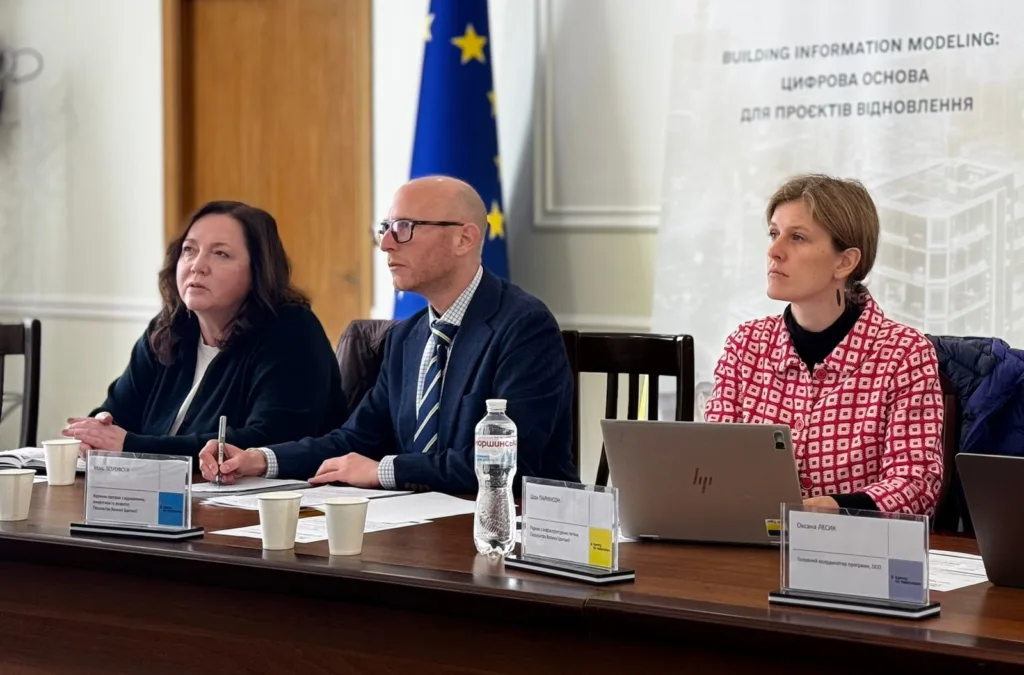
The Head of the Agency for Restoration presented key ongoing projects to the British partners, outlined strategic priorities, and emphasized the importance of a comprehensive approach to recovery.
“Among the Agency’s top priorities today are the protection of critical infrastructure and preparing communities for winter. In these projects, as in others, it is essential to implement BIM technologies. This is about transparency, control at every stage, and efficiency,” emphasized Serhii Sukhomlyn.

The Head of the Restoration Agency presented key ongoing projects to the British partners, outlined strategic priorities, and emphasized the importance of a comprehensive approach to recovery.
Among the priority areas is the protection of critical infrastructure facilities, which remains one of the key tasks in the context of national recovery. In this regard, it was highlighted that the use of Building Information Modelling (BIM) technologies could significantly improve the efficiency of such projects, ensure better coordination among stakeholders, and enhance both transparency and speed of implementation.
The Restoration Agency confirmed its readiness to transition to the design of complex infrastructure projects using BIM as a core project management tool.
From pilots to systemic implementation
A key focus of the meeting was the need to scale BIM adoption in Ukraine — moving from individual pilot initiatives to the systematic application of the technology across all stages of the asset lifecycle, from planning and design to construction and operation.
The first practical step in this direction is the implementation of the Agency’s pilot BIM project — the construction of the “Yahodyn” border crossing terminal. This project serves as a testing ground for developing standards, procedures, and technical solutions that will form the foundation for scaling BIM across the public sector.
Deputy Head of the Agency for Digital Development, Digital Transformation and Digitalisation, Roman Komendant, emphasized that with the support of British partners, the Digital Construction Office (DCO) has already been established to coordinate BIM implementation and oversee pilot projects.
According to him, a notable trend is the strong engagement from the private sector: companies involved in pilot projects are actively supporting BIM adoption and contributing to the development of minimum BIM requirements for design processes.
In addition, the Agency has approved a BIM Implementation Plan, which defines a step-by-step roadmap for the systematic integration of BIM into infrastructure recovery projects.
International support and capacity building
Representatives of the UK Embassy reaffirmed their commitment to supporting Ukraine in strengthening institutional capacity and implementing modern approaches in the infrastructure sector.
Head of Programmes for Recovery, Energy and Development at the UK Embassy, Max Petrofsky, noted that this was his first meeting within the mission and expressed deep respect for the work of the Restoration Agency under challenging conditions.
He emphasized that UK support programmes, including the FIRE programme, are aimed at strengthening the Agency’s capacity, supporting it through a complex period, and enabling the delivery of tangible infrastructure projects.
Infrastructure Advisor at the UK Embassy, Sian Parkinson, outlined the key areas of her work, focusing on supporting infrastructure development and promoting the adoption of modern implementation approaches.
Strategic partnership for sector transformation
The BIM implementation project is being carried out by the State Agency for Restoration and Infrastructure Development of Ukraine in partnership with Connected Places Catapult, with the support of FCDO.
The initiative aims to enhance transparency, accountability, and efficiency in the planning, design, and delivery of infrastructure projects, as well as to align Ukrainian practices with international standards, including ISO 19650.
The project is coordinated by the Digital Construction Office (DCO), which is responsible for implementing pilot solutions, strengthening the Agency’s capacity, and laying the groundwork for scaling BIM across Ukraine.
The adoption of digital technologies in construction is not only a response to current challenges, but also a foundation for a new model of infrastructure governance.
Cooperation with international partners, particularly the United Kingdom, plays a key role in enabling this transformation and creating the conditions for efficient, transparent, and sustainable recovery in Ukraine.